Traveling the Country: Protecting Consumers. Stopping Scammers.
As fraud tactics continue to evolve, education remains one of the most effective ways to help people protect themselves. Many scams begin by exploiting trust or compromising personal information well before any payment is made, making early awareness and prevention critical.
 By Adam Klappholz, Head of Product
Every scam begins with the same basic ingredient: a lie that feels real.
A text that looks like it came from your bank.
A message that sounds like a family member in trouble.
A social post pointing to a deal that feels too good to miss.
A fake ticket seller reaching fans before a major event.
Look closer, and the pattern is clear: scammers are not just trying to move money. They are trying to manipulate the moment before money moves.
That matters because today’s scams are becoming harder to spot. Criminals impersonate financial institutions, government agencies, businesses, charities and even loved ones. Artificial intelligence and social media have made these schemes faster, more personal and more convincing.
By the time someone is asked to send money, the scam may already be well underway.
That is why education remains one of the strongest tools we have.
Stopping Scams Before Money Moves
Scam prevention cannot begin and end at the payment. Many scams start upstream, long before a transaction takes place.
It starts with a message.
A call.
A post.
A conversation.
A moment of urgency.
And that is where education can make a real difference.
When people know the warning signs, they are more likely to pause, ask questions and think twice before sending money. That pause can be powerful. It can be the difference between recognizing a scam and becoming a victim of one.
Bringing Practical Tools to Communities
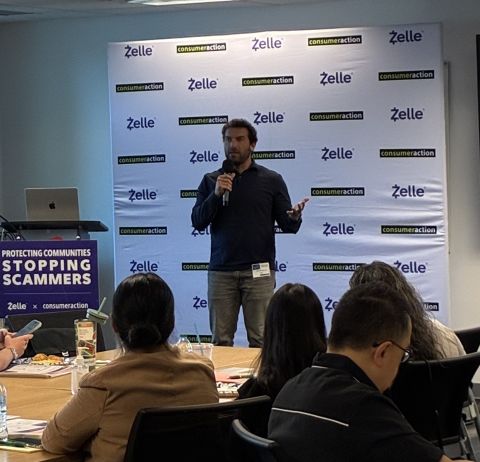
Last month, we partnered with Consumer Action in Chicago to host a scam and fraud prevention workshop for community leaders and advocates.
The event was built around a simple idea: reach the people consumers already trust.
Through this train-the-trainer program, community leaders receive practical tools they can bring back to the people they serve. Since its launch, the program has reached more than 150 community leaders across six cities.
Last week, that work continued in Seattle — a city that recently welcomed thousands of visitors from around the world as it hosted FIFA World Cup matches.
Major events can create new opportunities for scammers. Fake ticket sales. Fraudulent vacation rentals. Impersonation schemes targeting residents and visitors. The tactics may change, but the goal is the same: create urgency, build false trust and convince someone to send money.
That is why timely education matters. It gives consumers practical guidance when they need it most.