Title
Boomers Built Main Street. Now They’re Ready to Sell – But Gen Z and Millennials Aren’t Buying
Press Body

NEW YORK – A massive wave of small business owners is preparing to exit (often referred to as the "Silver Tsunami"), but the next generation isn’t lining up to take over.
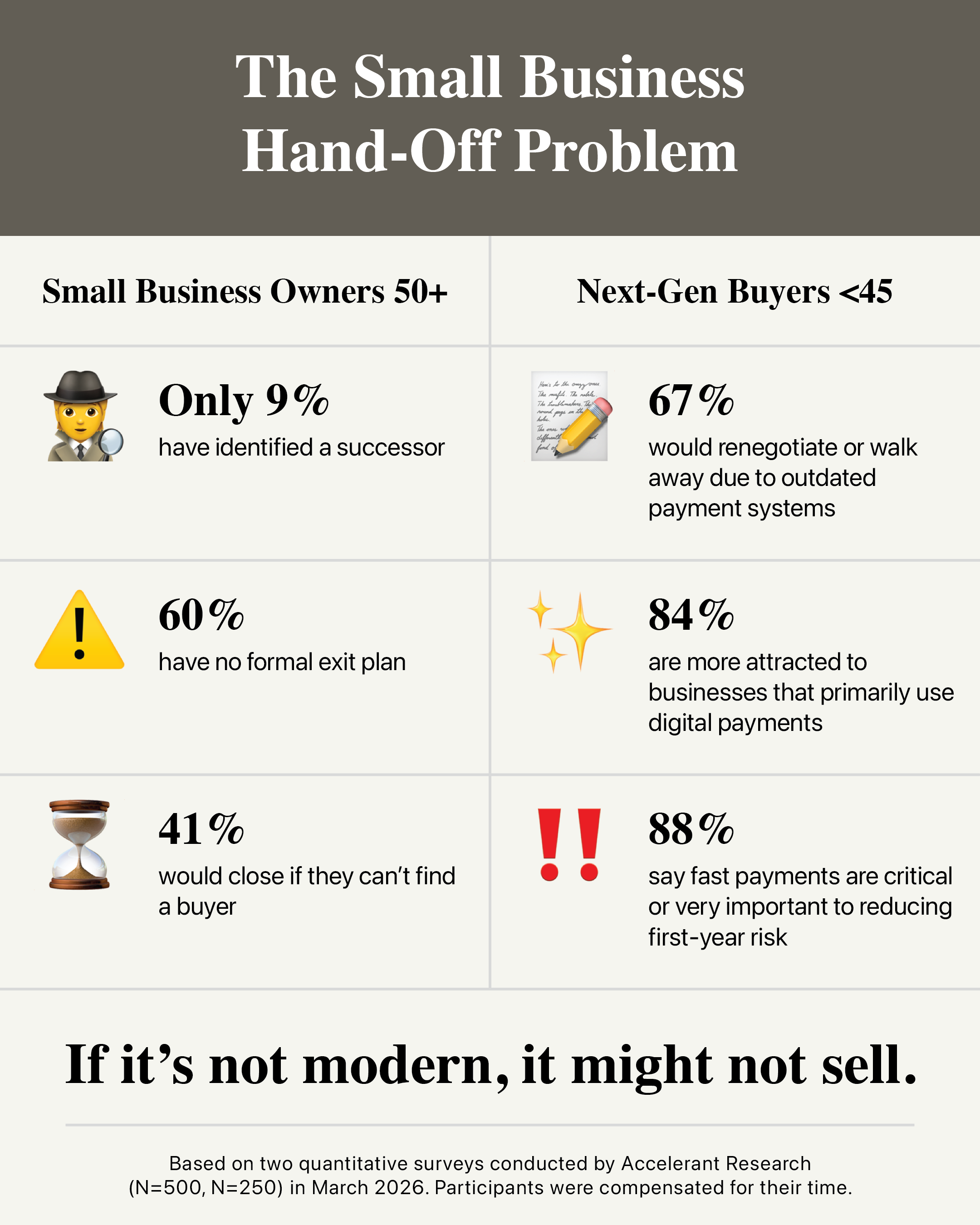
New data from the 2026 Zelle Small Business Pulse Report reveals a generational disconnect between retiring owners and younger buyers that is putting small businesses at risk of closing. While nearly half (49%) of small business owners over 50 surveyed plan to exit within the next decade, most lack a succession plan – and many may not meet the expectations of a generation raised on fast, digital-first payments.

The result: a looming shakeout on Main Street, where businesses that fail to modernize risk being passed over, but also offer a clear path for buyers to step in, upgrade operations, and unlock potential growth.

“There is a massive opportunity right now for the next generation of entrepreneurs to skip starting from scratch and instead buy and modernize existing businesses,” said Denise Leonhard, general manager of Zelle®. “For younger entrepreneurs, expectations are fundamentally different. Raised in an era of fast payments and creator-led businesses, speed, reliability and digital fluency are baseline requirements.”

The 2026 Zelle Small Business Pulse Report, which surveyed business owners approaching retirement and young or prospective entrepreneurs1, found:

  • Nearly 9 in 10 (88%) say receiving payments quickly are critical or very important to reducing first-year risk
  • 84% are more attracted to businesses that already operate digitally
  • More than two-thirds (67%) say outdated payment options could derail a deal altogether

At the same time, many existing businesses aren’t ready for these expectations:

  • 60% of small business owners have no formal succession plan
  • Only 29% say their business is modernized
  • 41% would shut down if they can’t find a buyer

The gap between what’s being sold and what buyers expect could determine whether millions of businesses change hands or disappear, with modernization emerging as a lever for increasing value amid barriers like financing, inherited liabilities and overall operational complexity.
 

The 9-to-5 Workday Is Dead for Small Businesses

Small businesses are already operating beyond the traditional 9-to-5 workday, and that aligns with what the next generation of small business owners expect.

In 2025, nearly half of the small businesses that used Zelle used it after 9 p.m., with more than a quarter active during midnight to 3 a.m. For Gen Z and Millennials, this kind of cash-flow is baseline for how and when businesses run.

Zelle is also powering high-value, business-critical transactions. Small businesses received an average of $477 per payment, with significantly larger amounts across certain key business functions like billing for completed work ($1,043) and recurring monthly payments ($627) for things like yard maintenance, daycare and social media services according to memo fields, a strong indicator that owners trust fast, reliable payments to run their operations.

“[Zelle] is connected to major banks, which gives them a lot of credibility. They keep excellent records financially, they have excellent confirmations as you're going through the process; everything's very transparent,” said Randi R., the owner of an interior design company in California. “It just expedites your business all around and saves you time and money.”

“As a small business owner, Zelle makes me feel like I can take care of my clients and make sure the business is consistent and thriving,” said Shawn W., the owner of a travel company in North Carolina. “You don't have to worry about funds just sitting for days, you will have access as soon as you need, and your clients will have access to funds as soon as they need.”

For businesses that come up for sale, the ability to move money quickly and operate digitally may determine whether they’re seen as an opportunity – or get overlooked.

Zelle is building for both sides of the transition:

Helping current owners modernize with tools like Zelle® tag, now used by more than half of newly enrolled small businesses. This feature allows small businesses to claim a custom handle (e.g., "brooklynbarbeque") that drops customer payments straight into the business’s eligible bank or credit union account — no email address or U.S. mobile number needed for the sender.

Investing in the next wave of entrepreneurs through the Zelle® Community Development & Entrepreneurship Scholarship, which awarded $10,000 to 10 MBA students at Historically Black Colleges and Universities (HBCU) that aspire to keep small businesses alive and local. The scholarship is a partnership between Zelle, the Congressional Black Caucus Foundation, and Community Development Investors.
 

About the 2026 Zelle Small Business Pulse Report

The 2026 Zelle Small Business Pulse Report is based on two national surveys conducted in March 2026 exploring the impact of the oncoming “Silver Tsunami,” a shift expected to see nearly 2.9 million baby-boomer small business owners retire by 2035.2

The first survey was of 500 small business owners age 50 and above. The second survey was of 250 Gen Z and Millennial current MBA students and/or MBA degree holders under the age of 45.3
 

About Zelle®

Zelle® powers fast, reliable person-to-person digital payments, moving more than $1 trillion between millions of consumer and small business accounts at United States banks and credit unions. Available through a network of more than 2,300 financial institutions, Zelle® enables people to send and receive money directly – without cash, checks or third-party apps. Zelle® is owned and operated by Early Warning Services, LLC, which works with America’s banks, credit unions and government agencies to drive prosperity, deliver bold innovation and improve how payments are made. Learn more at www.zelle.com.
 

Media May Contact:

Eric Blankenbaker
Eric.Blankenbaker@earlywarning.com
929.745.0923

Sidney McKenzie
Sidney.Mckenzie@earlywarning.com
646.276.0405


1 Defined as MBA students or MBA degree holders under the age of 45.
2 Perman, C. (2025, October 9). Employee ownership can help weather the “silver tsunami.” Harvard Business School. https://www.hbs.edu/bigs/silver-tsunami-employee-ownership
3 This consumer research was conducted by Accelerant Research in partnership with Early Warning Services, LLC. The quotes featured were obtained via Qualitative Interviews (N=12) in March 2026. A 10-minute online survey was conducted among 500 small businessowners (age 50+) and 250 MBA enrollees or recent graduates (age<45). Participants were compensated for their time.

Title
Zelle® and Truist Pilot Fast, Reliable Bill Payments
Press Body

NEW YORK, NY/CHARLOTTE, NC – Zelle® today announced a pilot with Truist Financial Corp. to evaluate the use of Zelle for bill payments, with Truist teammates participating in early testing ahead of broader consumer availability. The effort explores how greater payment certainty could help simplify one of the most common — and often stressful — financial tasks for consumers.

This pilot is part of Zelle® Forward, the network’s initiative focused on expanding Zelle into practical, real-world payment use cases, with Truist serving as the lead pilot partner for bill payments. After more than $1.2 trillion was sent using Zelle last year, the pilot examines how consumers could use Zelle to pay recurring credit card bills — with the potential for other bill pay applications such as rent, utilities, mobile services and auto payments — directly to billers with greater confidence around timing and confirmation.1

This work marks a shift from technical validation to everyday application — bringing Truist’s earlier milestone as the first financial institution to send and receive alias-based requests for payment with real-time settlement into a consumer-facing network. Testing now focuses on end-to-end predictability, using fast confirmation and posting behavior to support consistent outcomes for consumers and billers across routine bill payments.

“The problem with bill pay isn’t speed — it’s certainty,” said Chris Ward, head of Enterprise Payments at Truist. “Trust is built on knowing when a payment is received and how it posts, which is why we apply simplicity, speed, safety and smart execution, with a purpose-driven commitment, to meet this high frequency household need. Early testing aims to demonstrate how real time confirmation and alias based payments can deliver clearer outcomes for consumers and more predictable flows for billers.”

Traditional bill payment methods can involve processing delays that contribute to missed deadlines, late fees or service interruptions. In 2024, 17% of adults reported not paying all their bills in full in the prior month, highlighting the ongoing financial pressure many households face.2

The pilot points to several ways bill payments could function differently than traditional methods:

  • Improve certainty around when payments are received and confirmed
  • Strengthen transparency and security by eliminating the need to share account numbers
  • Support more predictable posting and reconciliation for routine payments
  • Accelerate access to funds for billers once payments are made
  • Reduce stress and uncertainty associated with due dates

In March, Zelle launched Zelle® Forward, an initiative focused on expanding the network into new, practical payment use cases in partnership with participating financial institutions.

“Zelle® Forward is about pushing beyond what’s possible today and we are proud to partner with Truist on this latest effort,” said Denise Leonhard, general manager of Zelle. “We’re focused on solving real problems – like the friction that comes with paying bills – and delivering a fast, reliable experience that consumers and businesses can count on.”

About Zelle®

Zelle® powers fast, reliable person-to-person digital payments, moving more than $1 trillion between millions of consumer and small business accounts at United States banks and credit unions. Available through a network of more than 2,300 financial institutions, Zelle® enables people to send and receive money directly – without cash, checks or third-party apps. Zelle® is owned and operated by Early Warning Services, LLC, which works with America’s banks, credit unions and government agencies to drive prosperity, deliver bold innovation and improve how payments are made. Learn more at www.zelle.com.

About Truist

Truist Financial Corporation is a purpose-driven financial services company committed to inspiring and building better lives and communities. Headquartered in Charlotte, North Carolina, Truist has leading market share in many of the high-growth markets in the U.S. and offers a wide range of products and services through wholesale and consumer businesses, including consumer and small business banking, commercial and corporate banking, investment banking and capital markets, wealth management, payments, and specialized lending businesses. Truist is a top-10 commercial bank with total assets of $549 billion as of March 31, 2026. Truist Bank, Member FDIC. Equal Housing Lender. Learn more at Truist.com.

Media May Contact:

Zelle
Eric Blankenbaker
Eric.Blankenbaker@earlywarning.com
929.745.0923

Truist
Don Wyar
Don.Wyar@Truist.com
214.335.6123
 

1 This pilot is a limited, exploratory and controlled test conducted with a participating institution. It is not available across the Zelle Network, and any broader deployment would depend on early learnings and whether future expansion is appropriate.
2 Federal Reserve. (2025). Economic well-being of U.S. households in 2024: Income and expenses. https://www.federalreserve.gov/publications/2025-economic-well-being-of-us-households-in-2024-income-and-expenses.htm

Title
Zelle® Announces Recipients of Scholarship to Help Address the “Silver Tsunami”
Press Body

NEW YORK – Zelle® and the Congressional Black Caucus Foundation (CBCF), in partnership with Community Development Investors (CDI), today announced the ten MBA students that have been named the inaugural recipients of the Zelle® Community Development & Entrepreneurship Scholarship, which was open to all MBA students in Entrepreneurship Through Acquisition (ETA) programs at five Historically Black Colleges and Universities (HBCUs):

  • Claflin University: Latisha Cuthberth
  • Howard University: Amanda C. Gayle, Kayla Isaacs, Carmen Ross
  • Jackson State University: Kazarius Bowie, Jordyn Martin
  • Morgan State University: Youssouf Barry, Khedema E. Robert
  • Virginia State University: India Nijae Bundy, Madison Traylor

“Millions of small businesses are approaching an ownership transition,” said Denise Leonhard, general manager of Zelle. “Zelle is committed to supporting small businesses, so Main Street remains strong. Supporting future small business owners by expanding access to education, tools, and opportunity is a direct extension of our commitment.”

Against the backdrop of a sweeping transfer of small business ownership – with nearly 2.9 million baby boomers projected to retire by 2035 – this scholarship supports aspiring small business owners at a pivotal moment in history.1

“The Congressional Black Caucus Foundation (CBCF) is committed to educational opportunities and training for the next generation of entrepreneurs,” said Nicole Austin-Hillary, president and CEO of CBCF. “This focused initiative provides a unique opportunity that builds upon the work of a generation to provide business ownership pathways for the next generation of leaders. The CBCF is proud to partner with CDI and Zelle to support small business and its future leaders.”

“Through our partnership with Zelle and the Congressional Black Caucus Foundation, we are helping to ensure that the next generation of business owners is more inclusive and better prepared to lead,” said Christopher Weaver, executive director of Community Development Investors. “As millions of small businesses transition ownership in the coming years, these students represent a critical pipeline of entrepreneurs who can step in, preserve jobs, and build wealth in underserved communities.”

Through its partnership with CDI, an initiative of the Economic Opportunity Coalition (EOC), Zelle supports the development of ETA programs, which are designed to prepare the next generation to acquire and grow existing small businesses post-graduation.

“Initiatives like this play a powerful role in increasing access to small business ownership by reducing financial barriers and expanding opportunities for aspiring entrepreneurs,” said India Bundy from Virgina State University. “For many individuals, especially those from underrepresented backgrounds, the cost of education and limited access to capital can delay or even prevent them from pursuing business ventures. Support like this allows students to focus on building the knowledge, skills, and networks necessary to successfully launch and sustain a business.”

“Carving out spaces for small business ownership not only creates pathways to creating independent wealth; it helps to create opportunities for entrepreneurs to explore creativity and innovation,” said Amanda C. Gayle from Howard University. “Affirming entrepreneurs through scholarships like this tells entrepreneurs you can be successful through the formation of your own ideas and that's powerful.”

The recipients were recognized at an event in Washington, D.C. on April 10, 2026.

Each student will receive a $10,000 tuition grant to support their MBA programs as they pursue business ownership through acquisition post-graduation.

About Zelle®

Zelle® powers fast, reliable person-to-person digital payments, moving more than $1 trillion between millions of consumer and small business accounts at United States banks and credit unions. Available through a network of more than 2,300 financial institutions, Zelle® enables people to send and receive money directly – without cash, checks or third-party apps. Zelle® is owned and operated by Early Warning Services, LLC, which works with America’s banks, credit unions and government agencies to drive prosperity, deliver bold innovation and improve how payments are made. Learn more at www.zelle.com.

About the CBCF

Established in 1976, the Congressional Black Caucus Foundation (CBCF) is a non-partisan, nonprofit, public policy, research, and educational institute committed to advancing the global Black community by developing leaders, informing policy, and educating the public. As a 501(c)(3), the CBCF takes no position on legislation or regulatory matters before Congress or any other government agency. Learn more at cbcfinc.org and follow @CBCFinc on all social platforms.

Media May Contact:

Eric Blankenbaker
Eric.Blankenbaker@earlywarning.com
929.745.0923

Sidney McKenzie
Sidney.Mckenzie@earlywarning.com
646.276.0405


1 Perman, C. (2025, October 9). Employee ownership can help weather the “silver tsunami.” Harvard Business School. https://www.hbs.edu/bigs/silver-tsunami-employee-ownership

Subscribe to